Kadamba Plateau in 2026: Why This Is North Goa’s Most Active Investment Corridor
Most Goa investment conversations still start with the coastal belt. Quietly, over the last four years, Kadamba Plateau has become the one address in North Goa where every serious infrastructure and institutional anchor is converging at once — and where the planning instruments, not the broker pitch, tell you why the window is open now.
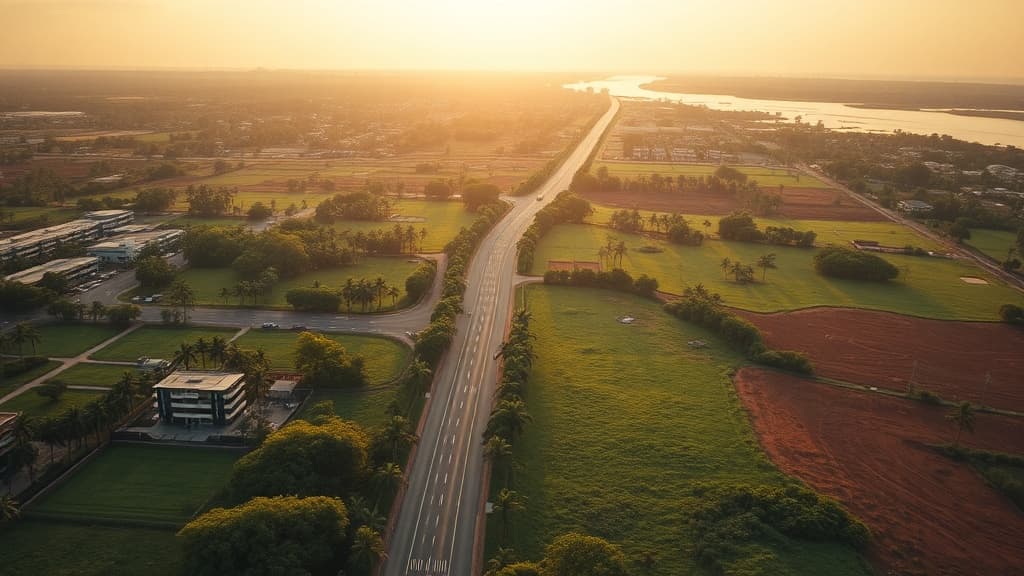
Most Goa investment conversations still start with the coastal belt — Assagao, Siolim, Anjuna, Morjim. Quietly, over the last four years, a different address has been doing more compounding work than any beachfront village. Kadamba Plateau, the high inland ground immediately adjacent to Panaji, is where the Government of Goa’s planning instruments, its institutional anchors, and the second international airport’s pull are all converging at the same time. The pricing and activity you see in 2026 are not a fluke — they sit on top of decisions made on the record, in writing, between 2021 and 2024.
This guide walks through what is actually in place at Kadamba Plateau as of early 2026, what has been formally notified and is a matter of public record, and — without speculation on price — why the combination makes the corridor the most active single investment zone in North Goa today.
Where Kadamba Plateau Actually Sits
Kadamba Plateau is the elevated landmass immediately north-east of Panaji, stretching across parts of Tiswadi taluka including the village of Chimbel. Its civic anchor is the Kadamba Bus Terminal — the largest road-transport terminus in Goa, named after the historic Kadamba dynasty — from which the plateau takes its name. The terminal handles intra-state and inter-state services and sits at the junction where traffic from NH-66 flows toward Panaji.
The plateau is within the Panaji Planning Area’s immediate periphery. Unlike Assagao or Siolim, which remain substantially village-character with built-form controls, Kadamba Plateau has been progressively designated for mixed-use development under Goa’s Town and Country Planning instruments. This is the single most important distinction for an investor: the permitted uses here are defined by the plan, not negotiated case-by-case.
The Planning Instrument: ODP-2031
In October 2021, the Government of Goa, through the Town and Country Planning Department, published the Kadamba Plan — the draft Outline Development Plan extending to 2031 — and in November 2021 notified it along with the ODPs for Panaji, Margao, and Ponda planning areas for public inspection. Copies were kept at the offices of the South Goa Planning and Development Authority and the relevant municipal bodies during the statutory consultation window that ran through December 2021.
An ODP is the primary instrument that defines land-use zoning, road alignments, and permitted built-form for a planning area. The Kadamba ODP-2031 replaced the earlier plan that was valid until 2028, extending the statutory horizon to 2031 and enlarging the scope of developable land within the corridor. For any buyer looking at a specific plot on the plateau, the operative question is which zone it sits within under this plan — that determines what can be built, and whether the buyer is acquiring land whose development rights are settled or contested.
The published plan is available through the TCP Goa portal. Any investor evaluating a Kadamba Plateau plot should insist on an extract showing the specific survey number against the notified ODP before committing. Plots that sit within clearly notified developable zones behave very differently from plots along the plan’s contested edges.
The Mopa Connection: Real and Quantifiable
The second lever driving Kadamba Plateau activity is Manohar International Airport at Mopa in Pernem taluka. The airport was inaugurated by Prime Minister Narendra Modi on 11 December 2022 and commenced commercial operations on 5 January 2023 with the first scheduled flight operated by IndiGo — dates that are on the Government of India Press Information Bureau record, not projections.
Unusually for a new airport, Mopa has run above plan. In financial year 2024–25, it handled over 4.6 million passengers, slightly in excess of its current Phase-I design capacity of 4.5 million. The airport’s master plan envisages expansion to 13.1 million passengers by the end of its fourth phase. What this means for North Goa land is structural: the airport is not a promise — it is already at capacity, and Phase-II expansion is the base case, not the optimistic case.
Kadamba Plateau sits on the road corridor between Panaji and Mopa. It is neither the beach location that holidaymakers fly into, nor the airport-adjacent zone where logistics and long-stay hospitality cluster. It is the middle — the administrative and commercial node that serves year-round economic activity in the state, of which the airport’s passenger volume is now a permanent multiplier.
The Anchors Already on the Ground
A corridor is as credible as the anchors committed to it. Kadamba Plateau carries several that are a matter of public record rather than marketing claim.
The IT Project at Chimbel: The Government of Goa has formally designated Kadamba Plateau, within the precincts of Chimbel village, as the location for the state’s IT Project — consolidating technology-sector activity in the corridor.
Goa Economic Development Corporation (EDC) commercial complex: EDC has announced a commercial development at Kadamba Plateau on the model of Patto Plaza, Panaji’s existing commercial hub. This was publicly stated by the Chairman, Goa EDC, and covered in state media in April 2022. It brings the kind of state-backed commercial asset that anchors retail and service businesses on a long-cycle basis.
New Goa BJP state headquarters: Construction of the state headquarters of the ruling Bharatiya Janata Party on Kadamba Plateau is underway. The Chief Minister, Dr Pramod Sawant, has publicly inspected the site. This is not an economic anchor, but it is a signal about the administrative centrality that state actors attribute to the corridor.
RERA-registered residential projects: The Goa Real Estate Regulatory Authority portal currently carries registered projects on Kadamba Plateau, including Carmo Lobo Estate — a residential group housing project on a 2,144 Sq Mt parcel, with project start date 26 February 2024 and project end date 31 December 2032. The presence of RERA-registered, active residential projects confirms that the corridor is now seeing disciplined developer capital, not just land banking.
Kadamba Bus Terminal itself: Daily footfall from intra-state and inter-state services creates a permanent demand base for retail, food and beverage, and service-sector commercial space. This is the single largest passenger-ground-transport volume in Goa, and it sits at the corridor’s southern edge.
Why the Window Is Now
Corridors that carry this combination of a notified ODP, a formally-sanctioned IT project, a state-backed commercial complex plan, RERA-approved residential construction, and the tailwind of India’s newest over-capacity international airport are rare even within Indian real estate. What makes the Kadamba Plateau window time-bound is that each of these has a clock on it.
- The ODP-2031 runs to 2031. The clearest zoning certainty is in the current plan period. Investment decisions made while a plan is active carry less zonal risk than decisions made at the plan’s renewal inflection.
- Mopa Phase-II is in planning. Capacity expansion decisions and their associated infrastructure notifications typically compress land pricing into the years leading up to them, not after.
- The IT Project and EDC commercial complex are anchor-dependent. Once operational, they reset the pricing baseline for adjacent land. Buying before operational absorption is a different exercise from buying after.
- RERA-registered residential inventory is finite. The plateau’s developable plots are a defined set under the notified ODP. As registered projects absorb land, the remaining inventory for future development shrinks.
None of this is an argument that prices only go up. It is an argument that the information asymmetry on this corridor — the gap between what the government has formally committed to and what most of the market has priced in — is the part of the cycle worth capturing.
Who Kadamba Plateau Suits
Commercial investors deploying ₹1.5–3 Cr: Ground-floor and first-floor commercial units in designated-use zones, with a mix of bus-terminal footfall and state-institution occupancy nearby. The corridor’s commercial thesis does not depend on tourism; it depends on year-round administrative and commercial activity, which is a more stable underwriting.
Land-bank investors on longer horizons: Settlement-zone plots with ODP clarity, held against the Mopa Phase-II and EDC anchors maturing over the next three to five years.
NRI investors seeking North Goa exposure without coastal regulatory overhead: Kadamba Plateau sits inland — no Coastal Regulation Zone complications, no 200-metre High Tide Line setback worries, no eco-sensitive coastal notification overlays. The regulatory profile of a plateau plot is substantially simpler than that of a beachside one at similar price points. See the companion NRI Goa guide for the FEMA, TDS and repatriation mechanics.
Residential buyers looking for a Panaji-adjacent address without Panaji pricing: The emergence of RERA-registered residential projects means the plateau now has genuine residential product under construction. For buyers whose priority is day-to-day Panaji access with modern built-form, the value equation works in a way it did not five years ago.
Points to Diligence Before You Buy
Planning instruments are an advantage on this corridor, but they are also the core area where due diligence must be exacting. Any Kadamba Plateau transaction should carry the following checks:
- ODP-2031 zoning extract for the specific survey number. Confirm the plot is in a settlement or commercial zone under the notified plan, not an eco-sensitive zone or a contested edge.
- Conversion certificate (Sanad) where the plot was previously agricultural, issued by the District Collector under the Goa Land Revenue Code.
- Form I and XIV (Record of Rights) verified directly from the DSLR portal — not from the seller’s photocopy.
- Thirty-year Encumbrance Certificate from the Sub-Registrar’s office.
- RERA registration verified on the Goa RERA portal for any project with more than eight units or plots.
- Occupation Certificate for any built property, issued by the relevant planning authority or panchayat.
For a complete walkthrough of Goa-specific buyer due diligence, see the ten-point checklist we keep as a working document for every transaction we handle.
Closing
Kadamba Plateau is not a speculative thesis — it is a corridor where the Government of Goa, a state-run commercial development authority, an IT-sector commitment, a national airport running above capacity, and RERA-regulated residential capital have all placed themselves on the record in the same place. The buyer’s question is not whether the corridor will grow. It is whether the specific plot, the specific unit, the specific builder, and the specific legal standing match the corridor’s underlying trajectory.
Listiing’s current inventory includes commercial shop units and a large-format settlement plot on the Kadamba Plateau corridor. Each listing is verified against title, zoning, conversion status, and RERA where applicable. Browse the full list at Listiing.com/property — or reach out to discuss a specific plot in detail.
Frequently Asked Questions
What is Kadamba Plateau and where is it located?
Kadamba Plateau is the elevated inland area immediately north-east of Panaji in Tiswadi taluka, North Goa. It takes its name from the Kadamba Bus Terminal, Goa’s largest road-transport hub, named in turn after the Kadamba dynasty that ruled Goa between roughly the 10th and 14th centuries. It includes parts of Chimbel village and sits within the Panaji Planning Area’s periphery.
When was the Kadamba Plateau ODP-2031 notified?
The Government of Goa’s Town and Country Planning Department published the Kadamba Plan in October 2021 and notified the draft ODP-2031 for public inspection alongside the Panaji, Margao, and Ponda plans in November 2021, with the statutory consultation window running through December 2021. The plan extends the planning horizon to 2031, replacing the earlier plan valid until 2028.
How does Mopa airport connect to Kadamba Plateau?
Manohar International Airport at Mopa (Pernem taluka, North Goa) was inaugurated on 11 December 2022 and commenced commercial operations on 5 January 2023. It handled over 4.6 million passengers in FY 2024–25, in excess of its 4.5 million Phase-I design capacity. Kadamba Plateau sits on the inland administrative corridor between Panaji and the airport, benefiting from year-round passenger-driven economic activity and the commercial scale-up that the airport’s over-capacity status implies.
What government-backed projects are coming up at Kadamba Plateau?
Publicly announced anchors include the State IT Project at Chimbel within the Kadamba Plateau precinct, a Goa Economic Development Corporation (EDC) commercial complex on the model of Patto Plaza in Panaji, and construction of the new Goa state headquarters of the BJP. The Kadamba Bus Terminal already operates as a primary road-transport hub generating daily footfall. RERA-registered residential projects — including Carmo Lobo Estate, with project dates of 26 February 2024 to 31 December 2032 — are also actively under construction.
Is Kadamba Plateau a good investment in 2026?
Kadamba Plateau offers a rare combination in Indian real estate: a notified Outline Development Plan active to 2031, state-sanctioned institutional anchors, operational second airport running above capacity, and RERA-regulated residential capital now on the ground. Whether any specific plot is a good investment depends on its zoning under the notified ODP, its title chain, and its price relative to comparable inventory. The corridor-level thesis is well-supported by on-record decisions; the parcel-level thesis requires diligence.
What should I check before buying a plot at Kadamba Plateau?
At minimum: (1) the ODP-2031 zoning extract for the specific survey number, (2) Sanad or conversion certificate where the land was previously agricultural, (3) Form I and XIV from the DSLR portal directly, (4) a thirty-year Encumbrance Certificate from the Sub-Registrar, (5) RERA registration on the Goa RERA portal for any qualifying project, and (6) an Occupation Certificate for built property. Goa’s planning and land records are among the more technically involved in India — a Goa-based property advocate’s fee is small relative to the downside of missing any of these.
People also ask
Quick answers on this topic.
- What is Kadamba Plateau and where is it located? +
- Kadamba Plateau is the elevated inland area north-east of Panaji in Tiswadi taluka, North Goa. It takes its name from the Kadamba Bus Terminal — Goa’s largest road-transport hub, named after the Kadamba dynasty — and includes parts of Chimbel village, within the Panaji Planning Area’s immediate periphery.
- When was the Kadamba Plateau ODP-2031 notified? +
- The Goa Town and Country Planning Department published the Kadamba Plan in October 2021 and notified the draft ODP-2031 for public inspection in November 2021 alongside the Panaji, Margao and Ponda plans. The plan extends the planning horizon to 2031.
- How far is Kadamba Plateau from Mopa airport? +
- Kadamba Plateau sits near Panaji in central North Goa, while Manohar International Airport is at Mopa in Pernem taluka to the north of the state. The two are connected via the NH-66 corridor. Travel time depends on traffic and route — always check current routing via a live navigation tool before planning a journey.
- Is Kadamba Plateau a good investment? +
- Kadamba Plateau offers a rare combination: a notified Outline Development Plan to 2031, state-sanctioned anchors (IT Project at Chimbel, EDC commercial complex, new state party headquarters), an over-capacity second international airport on the same corridor, and RERA-registered residential projects actively under construction. The corridor-level investment case is well-supported by on-record decisions; the parcel-level case requires individual diligence.
- What kind of property is available at Kadamba Plateau? +
- The corridor carries a mix of commercial shop units in designated commercial zones, settlement-zone plots for residential or mixed development, and RERA-registered apartment projects. The specific use-matrix for any plot is governed by its classification under the notified ODP-2031.
- What due diligence is essential before buying at Kadamba Plateau? +
- Verify: the ODP-2031 zoning extract for the specific survey number; Sanad or conversion certificate where relevant; Form I and XIV from the DSLR portal; thirty-year Encumbrance Certificate from the Sub-Registrar; RERA registration on Goa RERA portal where the project qualifies; and Occupation Certificate for built property.
Have a question?
Talk to us about what you read.
If this piece raised questions about a specific property or corridor, drop us a line. Short, honest replies — that's all we do.
More in Goa Real Estate