Ready-to-Move vs Under-Construction Property in Goa: Making the Right Choice
The ready-to-move versus under-construction choice is one of the most consequential decisions a property buyer makes in Goa. The financial implications — GST liability, construction risk, delivery timeline, and rental yield from day one — are significant enoug
The ready-to-move versus under-construction choice is one of the most consequential decisions a property buyer makes in Goa. The financial implications — GST liability (5% on under-construction residential, NIL on completed property with OC), construction risk, delivery timeline, and rental yield from day one — are material enough to change the effective cost of a property meaningfully. Here is a structured framework for making the right choice.
The Ready-to-Move Advantage
No GST: Completed residential properties (with Occupancy Certificate) are exempt from GST. Under-construction properties attract 5% GST (or 1% for affordable housing) on the transaction value. On a Rs 3 Cr property, this is Rs 15 Lakhs saved — a material amount.
What you see is what you get: For luxury buyers in Goa, the actual views, natural light, landscape, privacy level, and build quality of a completed property can only be truly assessed in person. Many buyers in the Rs 3-15 Cr range have found that the completed product differs materially from the renders and commitments made at the time of under-construction purchase.
Immediate rental income: Goa’s premium short-stay rental market is active year-round but concentrated in the October-March peak season. A property that delivers in May may miss an entire peak season before generating the rental income that justified the investment.
The Under-Construction Advantage
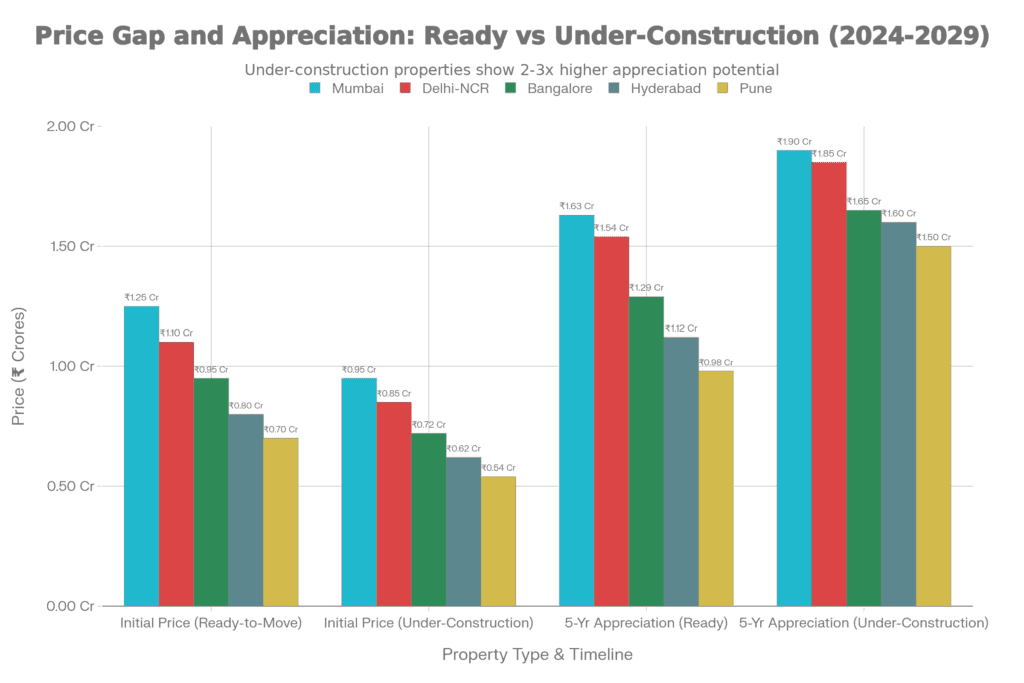
Price advantage: Developers typically price under-construction inventory below the expected completed market value to compensate buyers for the construction and delivery risk they are taking on. The discount is project-specific — driven by developer track record, stage of construction, RERA status, and competing inventory — rather than a fixed percentage. If the developer delivers on time and spec, that discount more than compensates for construction risk.
Customisation: Buying early in a development allows buyers to influence interiors, unit selection (floor, orientation, specific unit), and sometimes layout modifications. This is particularly valuable for premium buyers who want specific views or finishes.
Payment flexibility: Under-construction properties offer construction-linked payment plans that spread capital deployment over 18-36 months, improving capital efficiency for buyers with other investment commitments.
The Risk Assessment
Goa-specific risks for under-construction property that buyers often underestimate:
- RERA status: Verify the project is registered with Goa RERA (Real Estate Regulatory Authority). Unregistered projects carry significantly higher risk of delay and non-delivery.
- Developer track record: Goa has had well-publicised cases of developers who delivered 3-5 years late or not at all. Check the developer’s completed project portfolio, not just their current launches.
- Approval chain: Environmental clearances, TCP approvals, and Panchayat NOCs must all be in place before you commit. A project that is pre-approval is speculative, not investment-grade.
The Verdict for Premium Goa Buyers
For buyers above Rs 2 Cr in the luxury segment, ready-to-move properties from verified sellers with clean title are typically the safer and often better-value choice — the GST saving, delivery certainty, and ability to assess the actual product outweigh the nominal price advantage of under-construction buying. Under-construction makes more financial sense only when the developer has an established delivery record, the project is RERA-registered with clean approvals, and the price advantage is material enough to absorb residual construction risk.
Listiing’s inventory is exclusively verified, completed, and ready-to-transact — no under-construction projects where you are buying from a brochure.
Frequently Asked Questions
Is ready-to-move property better than under-construction in Goa?
For most HNI buyers in Goa above Rs 2 Cr, ready-to-move property is the better choice. You save GST (5% on under-construction residential), eliminate construction and delivery risk, can assess the actual product before committing, and generate rental income immediately. Under-construction can outweigh these factors when the developer is RERA-registered with a proven delivery record and the project's price advantage is material enough to absorb residual construction risk.
What GST applies to property purchase in Goa?
Completed residential properties (with Occupancy Certificate) are exempt from GST on resale. Under-construction residential projects attract 5% GST (without input tax credit). Under-construction affordable housing (under Rs 45 Lakhs with carpet area below 60 sq m) attracts 1% GST. Commercial properties under construction attract 12% GST. GST does not apply to land-only transactions.
How do I verify a developer is RERA registered in Goa?
Visit the Goa RERA website (rera.goa.gov.in) and search for the project by name or registration number. A valid RERA registration is mandatory for projects with more than 8 units or a plot exceeding 500 sq metres. Never commit to an under-construction project without verifying RERA status — unregistered projects offer no legal recourse for delay or non-delivery.
Can I negotiate the price of ready-to-move property in Goa?
Yes, particularly for properties that have been on the market for 6+ months or where the seller has a timeline-driven motivation. Premium properties with strong fundamentals (clear title, prime village, unique character) rarely discount significantly. Properties with minor title or documentation issues, or in less liquid markets, offer more negotiation room. Always negotiate after completing due diligence, not before.
What is the payment process for buying property in Goa?
The standard Goa property purchase process involves: token payment (1-5%) on verbal agreement, Sale Agreement registered at Sub-Registrar with 10% deposit, balance payment within the agreed timeline (typically 30-90 days), and final Sale Deed registration with stamp duty and registration charges paid. Stamp duty in Goa is a progressive slab (3% up to ₹50 Lakhs, scaling to 4.5% above ₹1 Crore) plus a registration fee (2%–3.5% across the same bands). Goa does not offer a gender-based concession on stamp duty.
People also ask
Quick answers on this topic.
- What is the difference between ready to move and under construction? +
- Ready-to-move (RTM) property has received Occupancy Certificate (OC) and is ready for possession. Under-construction (UC) property is still being built, with possession typically 12-48 months out. The two have very different cost structures, GST treatment, and risk profiles.
- Which is cheaper — ready to move or under construction? +
- UC is generally launched below expected completed-market value to compensate buyers for construction and delivery risk, but it attracts 5% GST (1% for affordable housing) on the construction value. RTM with OC has no GST but commands a higher base price and requires full cash flow upfront. Net of GST, the gap narrows; the actual cost difference is project-specific, driven by developer, stage, and competing inventory.
- What are the risks of under-construction property? +
- Construction delays (regularly 6-24 months even for established developers), title and approval risk, developer financial health, and the gap between brochure and final delivery. RERA registration mitigates some of these but does not eliminate them.
- Is it okay to buy a flat without OC? +
- No. Without an Occupancy Certificate, the building is technically unauthorised for occupation, and you may face issues with utility connections, resale, and even possession. Always insist on OC before taking possession of an RTM purchase.
- For Goa specifically, is RTM or UC better? +
- Goa has fewer mass-developer projects and more boutique/heritage inventory. Most premium Goa properties are RTM (heritage homes, completed villas) or land. UC plays mainly come up in the larger residential/commercial clusters like Kadamba Plateau and Mopa corridor. Match the format to your hold period and risk appetite.
Have a question?
Talk to us about what you read.
If this piece raised questions about a specific property or corridor, drop us a line. Short, honest replies — that's all we do.
More in Buying Guide